
Property Management Software for Australian Landlords: What Matters in 2026
Comparing property management software in Australia? Explore the trade-offs for self-managing landlords, from rent records and repairs to real costs, state support and platform availability.

Choosing landlord software in 2026: look beyond the feature list
Property management software for Australian landlords should help you keep rental records, communication and follow-up work organised. The right choice depends on your property, your state or territory, and how much of the day-to-day management you are willing to do yourself. A long feature list is less useful than a clear answer to one question: can this platform support the rental you actually own?
If you are comparing landlord software in 2026, separate three things: what is available now, what is included in the price, and what remains a preview or roadmap item. This matters when considering an emerging platform such as RentSeekr as much as it does when reviewing an established service.
This article is RentSeekr’s editorial perspective on the decision, reviewed on 20 October 2026. It is a buying framework, not an independently tested ranking of competing platforms.
Self-managing software or a property manager: what are you buying?
A property manager supplies a service: people take on agreed work under a management agreement. Landlord software supplies tools. Unless a separate service is included, you still organise repairs, respond to renters, make decisions and check your obligations.
For a landlord with one rental and time to manage it, a spreadsheet, calendar and organised document folder may be a workable starting point. A dedicated platform becomes more attractive when messages, rent entries and maintenance tasks start to fragment across several places. For an owner who cannot reliably respond during a working day or coordinate local help, professional management may still be the better fit.
Compare the work you want handled before comparing prices. Write down who will answer an urgent call, who will attend an inspection and who will keep the records current. Software can make those responsibilities clearer; it does not automatically take them over.
Rent tracking: a clear ledger beats a headline balance
When comparing rental property management software, ask to see how a rent entry is recorded and corrected. Can you distinguish the period covered, the date received, a partial payment and an adjustment? Can you retrieve the supporting record later? A dashboard total alone is not enough to explain a discrepancy.
Also separate recording rent from collecting it. A platform may provide a ledger without moving money. If payments are offered, check supported methods, processing charges, settlement timing and what happens when a payment fails. Do not assume a “paid” label means funds have reached your bank.
For your trial, use fictional figures: one expected payment, one partial payment and one correction. Ask how the record can be exported when you leave. These are evaluation questions, not claims that every platform supports these functions.
Maintenance and tenant communication need an owner and a next step
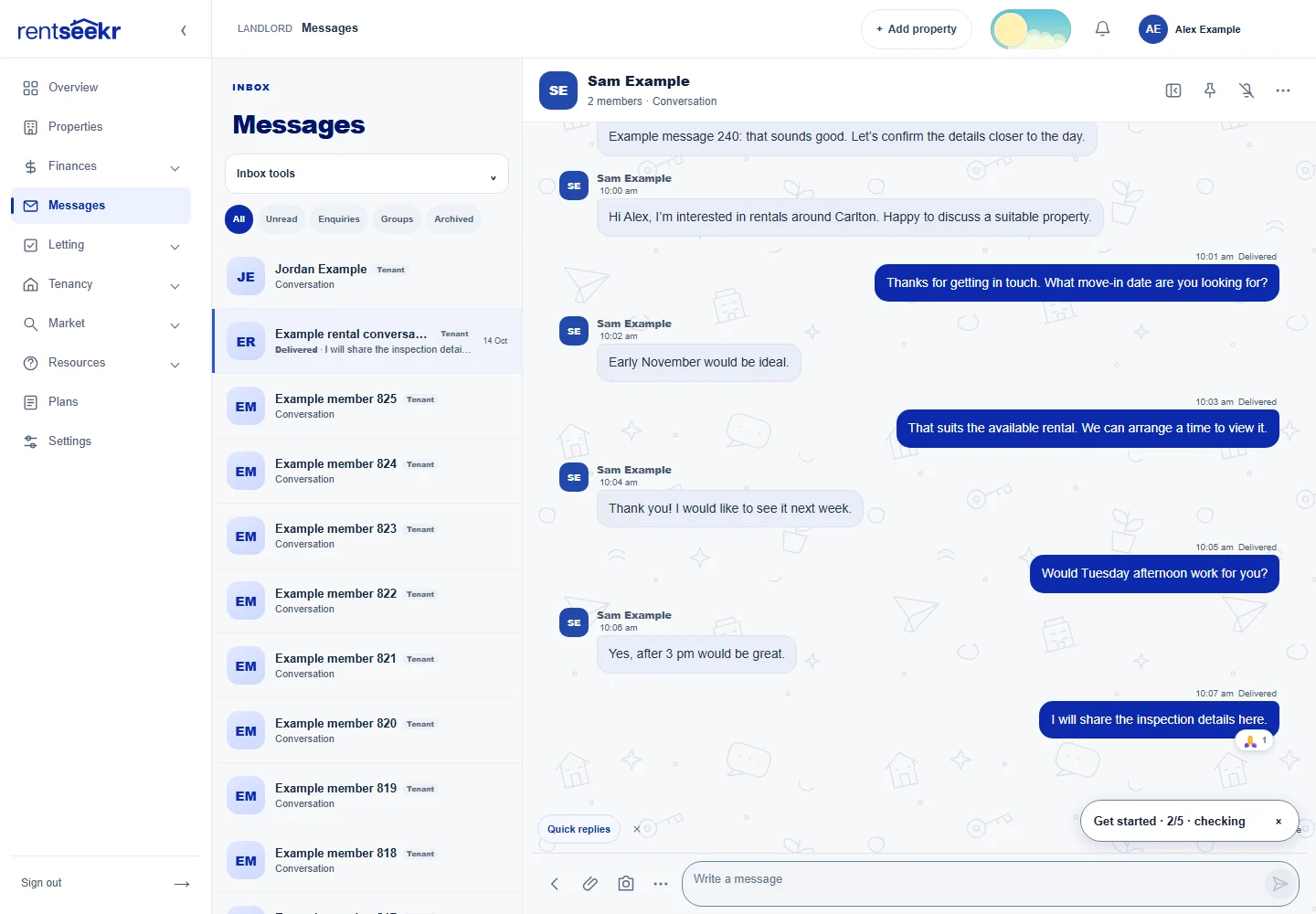
A useful maintenance workflow makes it clear what was reported, when it arrived, who is responsible and what happens next. Look for property-linked messages, attachments and a visible history. Check whether the renter can tell that a request has been received and how you will follow up outside the platform.
A message inbox is not an emergency response service. Make sure renters know the appropriate urgent contact process and that you have a practical plan for responding. Consumer Affairs Victoria separates repairs, minimum standards and safety information in its renting guidance; your software decision should account for those responsibilities rather than treating every issue as an ordinary task.
Test this with a fictional leaking tap: submit the report, add a photo, record a proposed visit and find the conversation again from the property record. Repeat the exercise on a phone. If you cannot see the next action quickly, a large feature list will not solve the underlying problem.
Australian support must match your state and rental type
“Built for Australia” is a starting point for questions. Ask which state or territory, agreement type and property arrangement each workflow currently supports. Whole-property rentals and room arrangements may follow different processes. A template, an electronic signature and a calendar reminder are separate capabilities; none alone proves the correct process has been followed.
Check the current official guidance for your property. For example, Consumer Affairs Victoria provides distinct information about rental agreements, condition reports, repairs and entry. Do not carry a Victorian workflow into another jurisdiction without checking its requirements.
Look at access as well as documents. Ask who can see application attachments, tenancy records and messages; how access changes when a tenancy ends; and what can be exported or removed. Use synthetic information for a demonstration instead of uploading a real applicant’s identity documents.
Compare the full cost of landlord software
Put each option on the same annual basis. Include the subscription, any per-property charges, optional advertising, payment processing, onboarding and the services you will still purchase separately. Check whether quoted amounts include GST and whether annual billing creates a commitment. A lower subscription does not necessarily mean a lower total cost.
Illustrative arithmetic only: a $30 monthly subscription is $360 a year. A hypothetical management charge of 7% on $600 weekly rent for 52 paid weeks is $2,184 a year, before any other charges. These are invented assumptions, not market quotes or a RentSeekr price comparison. The services and responsibilities differ, and your actual rent, occupancy, tax treatment and contract may change the result.
Value your own time too. If self-management means arranging trades, attending inspections and keeping the ledger current, include those hours in the decision. RentSeekr’s public savings calculator can help you explore your own assumptions; an estimate is a planning tool, not a guaranteed saving.
A five-question trial for landlords with one or a few properties
Use the same fictional rental for every demonstration and ask five practical questions.
- Can I find the agreement, latest communication and outstanding work from one property view?
- Can I understand and correct a rent record without losing the explanation?
- Can both sides follow a maintenance report from receipt to completion?
- Can I complete the common tasks on my phone and retrieve my records when I leave?
- Which of these functions are live today, included in my plan and supported for my state?
Record the answers as available, limited, planned or unverified. Do not score a roadmap promise as an available feature. If you are moving from an agent, also ask what information must be transferred, who checks it and when each management responsibility changes hands. Choosing software should come after that practical handover discussion.
Where RentSeekr fits in your shortlist
RentSeekr is developing a direct rental platform that brings property information, conversations and tenancy work into a connected workspace. Its public tour shows actual product screens with synthetic example records, including messaging, applications and condition reports. It also explains supported Victorian agreement and tenancy workflows.
As reviewed on 20 October 2026, public account access remains limited while RentSeekr prepares for launch. The provider pricing page is a catalogue preview, and inclusions have different product phases. Treat a screenshot or intended inclusion as something to explore, not a promise that you can activate it today.
If your aim is to manage a rental more directly, use the tenancy-management tour to see the approach, read the current pricing and availability notes, and contact RentSeekr about your property, location and intended workflow. That gives you a concrete discussion about fit before you commit to changing how your rental is managed.
Questions landlords ask about property management platforms
What is the best property management software for a private landlord in Australia? The best fit depends on your state, property type, portfolio size, budget and available time. Start with rent records, communication, maintenance, document access and current availability. A universal ranking cannot substitute for testing your own workflow.
Do I need landlord software for one property? Not necessarily. An organised manual system may be sufficient. Software is worth evaluating when records become difficult to reconcile, follow-ups are missed or you want a clearer shared process with your renter.
Can software replace a real estate agent? It can support self-management, but tools do not automatically perform the services in an agency agreement. Decide who will handle each responsibility and check the handover requirements before changing arrangements.
Does a platform make my rental compliant? Do not assume so. Check current official requirements for your state and rental type, and verify the platform’s supported scope. Seek appropriate advice where a specific situation needs it.
Sources and further reading
Reviewed on 20 October 2026. Product statements are based on RentSeekr’s public website, not independent performance testing. Official Victorian information is relevant to Victoria; landlords elsewhere should use their own state or territory authority.
Consumer Affairs Victoria — Renting: https://www.consumer.vic.gov.au/housing/renting
Consumer Affairs Victoria — Repairs, alterations, safety and pets: https://www.consumer.vic.gov.au/housing/renting/repairs-alterations-safety-and-pets
RentSeekr — Public product overview and screenshot sources: https://rentseekr.com/
RentSeekr — Current pricing preview: https://rentseekr.com/pricing
Hero photograph: Curtis Adams / Pexels — https://www.pexels.com/photo/comfortable-couch-in-the-living-room-4320374/ (Pexels licence: https://www.pexels.com/license/). Stock image for illustration, not a RentSeekr listing. The in-article product screenshot is supplied by RentSeekr and uses synthetic example data. No customer records or independent research data are presented. For step-by-step rental information, explore RentSeekr’s landlord guide library.
Explore a more connected way to manage your rental
See whether RentSeekr fits your rental
Tell us where your property is, whether it is already tenanted and which management tasks you want to handle directly. We can discuss the current product scope and availability before you plan your next step.
RENTSEEKR CITY · LOCAL DISCOVERY
Looking for useful help in your area?
Choose a published City market and optional suburb or postcode to see active, approved services listed for that area. This article does not determine your location.
Choose a published City market; no location is inferred from this article.